

P. Meier
Evolution
The deep roots of Carnivora
The earliest ancestors of today's carnivores — the Carnivoramorpha — appeared around 60 million years ago, shortly after the extinction of the dinosaurs. By 45–50 million years ago, this group had split into two broad lineages: the Feliformia (cat-like carnivores, including today's cats, hyenas, and mongooses) and the Caniformia (dog-like carnivores, including dogs, bears, and mustelids). The first species considered to be true felids appeared around 34 million years ago.
Before the true cats, however, there were groups that looked strikingly similar. The Nimravidae and Barbourofelidae — sometimes called "false cats" — were cat-like carnivores that evolved long canines and a broadly similar body plan, but are not considered true felids. The key distinction lies in the structure of the auditory bulla, a small capsule in the middle ear whose anatomy differs markedly between these groups and true cats. Convergent evolution — where unrelated lineages independently develop similar features — produced cat-like animals multiple times, including among South American marsupials such as the saber-toothed Thylacosmilus, and in Australia, where Thylacoleo (the "marsupial lion") persisted until relatively recently.
Nimravidae – “false” cats

Artist’s reconstruction of Barbourofelis fricki. The species belongs to the Barbourofelidae, a family of animals that look similar to cats, but are not “true” cats (illustration by M. Antón in Antón 2013a).
What is a “cat”? Cats look clearly different from other carnivores e.g. dogs. But even within today’s fauna there have been debates; the fossa Cryptoprocta ferox has, e.g., in the past been assigned to the cats, the viverrids or the mongooses, before being placed in the euplerids. This problem is exacerbated in species only known from fossils.
There is a principle in phylogeny (the construction of family trees showing the lineage of species, genera, etc.): all members of a named group should go back to a common ancestor. Consequently, all the cats should share various characteristics that they have all inherited from their common ancestry. This is confounded by evolutionary processes; some characteristics will change in some members of the group (“divergent evolution”), and some completely unrelated groups may develop similar characteristics shaped by their environments (“convergent evolution”).
The family Nimravidae (not to be confused with the genus Nimravides!) has in the past been regarded as comprising “cats.” This is the case with the Barbourofelidae, which appear later in the fossil record than nimravids, but may be descended from them. Most of the species in these families had long canines like the famous now extinct true saber-tooth cats (see below). In fact, the Nimravidae and Barbourofelidae are sometimes also called false saber-tooth cats. They are believed to have had a similar lifestyle as cats, yet they are not regarded as cats. What distinguishes them from the true cats is a small part of their skeletal structure, namely the auditory bulla in the skull. The auditory bulla is a capsule in the middle ear. The structure of this capsule is key to distinguishing between carnivoran families in the fossil record. In the cats, the bulla is made of bone, with an additional septum separating the two chambers. In some Nimravidae the bulla is missing from the skull, implying that it did not consist of bone, but of cartilage. In other Nimravidae as well as Barbourofelidae, there is a bony bulla, but its shape and internal structure are quite different from that of cats. Consequently, these families have been placed within the Feliformia (see above), but not within the “true” cats.
Other examples of species that look like cats and/or have been named after cats can be found, e.g., among the marsupials. The saber-toothed Thylacosmilus from South America was about the size of a jaguar, and in Australia, the “marsupial lion” Thylacoleo could be found until quite recently.
Proailurus: the first true cat
The earliest animals considered to be actual cats belong to the genus Proailurus, which lived approximately 34–20 million years ago. Three species are recognised — P. lemanensis, P. bourbonnensis, and P. major — ranging in size from roughly ocelot-sized (P. lemanensis, shoulder height ~38 cm) to as large as a Eurasian lynx (Lynx lynx) (P. major, ~23 kg). Fossils have been found primarily in France, Germany, and China. P. lemanensis, the best-known species, was likely at least partially arboreal, based on the structure of its feet and ankles. Overall, Proailurus was very similar to living felids, with only minor differences in dentition and limb proportions.
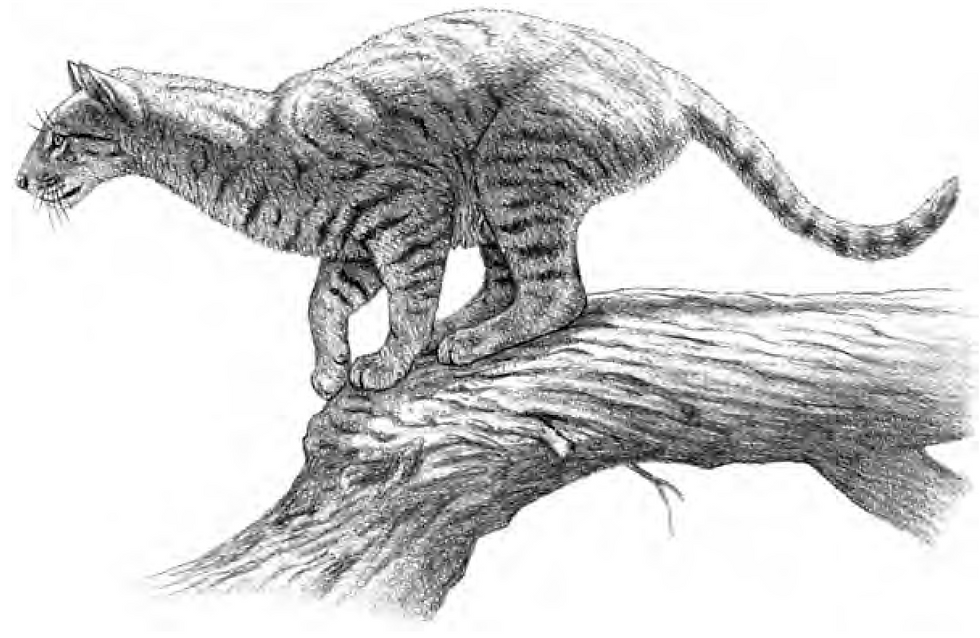
Artist’s reconstruction of Proailurus lemanensis, the first cat (illustration by M. Antón in Turner & Antón 1997).
The great divergence: saber-tooth cats and living cats
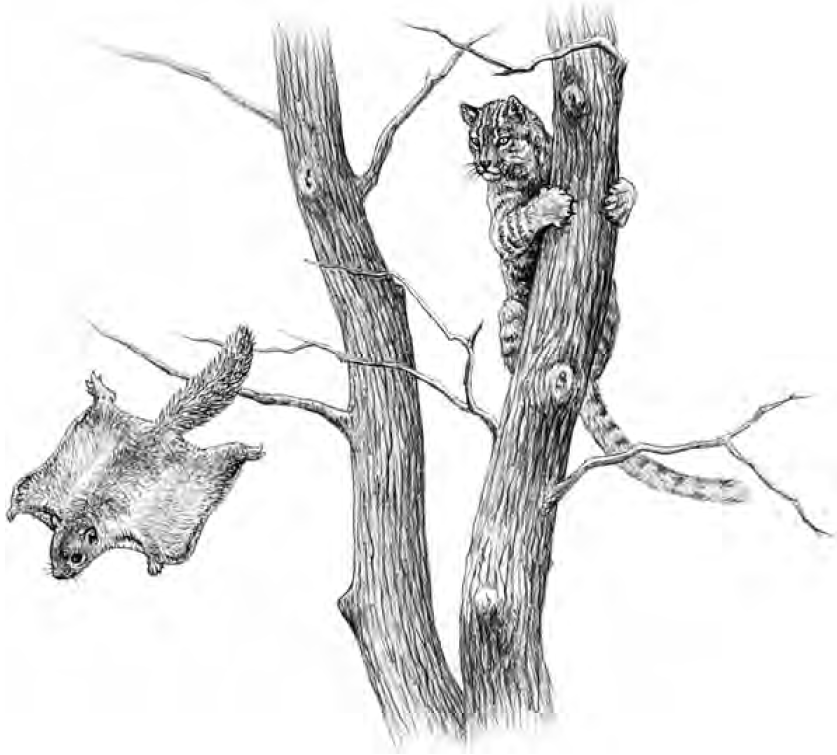
Artist’s reconstruction of Styriofelis (or Miopanthera) lorteti, together with a flying squirrel Petaurista sp. (illustration by M. Antón in Werdelin et al. 2010).
From the single point of origin – Proailurus – the situation becomes more complex as the cat family experienced a radiation into different lineages starting around 20 million years ago. At one time the systematics showed only one direct descendant from Proailurus, namely Pseudaelurus. This genus contained 11 named species, 5 from North America, 4 from Europe and Arabia and 2 from China. At various times these species were split into separate genera and now we recognize at least three genera: Pseudaelurus, Styriofelis and Hyperailurictis.
The genus Hyperailurictis includes five North American species. Their descendants were the 4 species of Nimravides (not to be confused with the family Nimravidae), which appeared around 14 million years ago and went extinct around 6 million years ago without leaving any further descendants.
Meanwhile, Pseudaelurus sensu stricto included three species: the two Chinese species P. guangheensis and P. cuspidatus, and P. quadridentatus which is known from fossils from France and Spain. The status of a fourth species, P. romieviensis, is uncertain. P. quadridentatus was about the size of a puma with a weight of approximately 30 kg. It was the first “true” cat that showed a trend toward longer upper canines. The descendants of Pseudaelurus developed into the Machairodontinae, the saber-tooth cats.
According to the suggested split (see above, and Fig. in the introduction), the genus Styriofelis included S. turnauensis and S. lorteti and gave rise to the Felinae, which comprises all of today’s living cat species. Fossils of S. turnauensis were found in Germany, Spain and Saudi Arabia. It was about the size of a wildcat and arboreal. S. turnauensis is the oldest and most primitive species of this entire complex of Styriofelis, Pseudaelurus and Hyperailurictis, but also survived the longest. The last fossils lived around 8 million years ago, some two million years later than the last fossils of S. lorteti and P. quadridentatus. It is suspected that this is due to its arboreal lifestyle, which helped it avoid competition with the terrestrial, early machairodonts. S. lorteti was the size of a lynx and also showed adaptations to a more arboreal lifestyle. In 2012, a new species was found in Spain and named S. vallesiensis. In 2017, this species was moved to a new genus and is now known as Leptofelis vallesiensis. It shows more slender legs than Styriofelis and was more adapted to running rather than climbing. Also in 2017, a species that had previously been described as Felis pamiri was found to be closely related to S. lorteti, and F. pamiri and S. lorteti were moved together to form the new genus Miopanthera, a genus close to, if not part of, the Panthera clade.

The Machairodontinae persisted for a very long time, from around 18 million years ago to 11’000 years ago. They first evolved in Eurasia, but subsequently spread around the world. They include some of the most famous pre-historic animals: the saber-tooth cats. The Greek “machaira” means sword and “dont” tooth. There have been many different species of saber-tooth cats. The Machairodontinae are a subfamily that contains some 15 genera and is divided into 4 tribes – the Metailurini, the Machairodontini, the Homotheriini and the Smilodontini (although sometimes the Machairodontini and the Homotheriini are merged). Overall, their size varied from that of a lynx to larger than a lion. Their most prominent feature was their upper canines. In some species, these reached lengths of up to almost 30 cm and protruded far past the chin. Many had very massive upper bodies, incl. a large head, which was more elongated than in today’s cats, an elongated and very muscular neck, a large ribcage and long, strong front legs with particularly robust legbones. Their back legs were strong, too, but usually slightly shorter, which made their silhouette resemble today’s hyenas. Some Machairodontinae had a short tail. As pointed out above, the Machairodontinae are not the ancestors of the living cat species, but a sister group that evolved in parallel with the ancestors of living cat species.
Reconstruction of the body proportions of D. barlowi (top) and D. piveteaui (middle) compared to a modern leopard (Panthera pardus; bottom). The scale bar is 25 cm (Werdelin & Lewis 2001).

Several genera have been assigned to the tribe of the Metailurini, including Adelphailurus, Metailurus, Stenailurus (possibly a synonym to Metailurus), Dinofelis and, most recently, Yoshi. However, the systematics of this tribe is not unanimously accepted. In fact, Werdelin et al. (2010) call the Metailurini “essentially a waste-basket for taxa that show some saber-tooth features but cannot be placed in either the Machairodus or the Paramachairodus lineages.” Many species had normal sized canines, but more flattened than in living cats. Some authors have suggested that, e.g., Metailurus is closer to the Felinae than to the Machairodontinae, i.e., that they were conical-toothed cats with a tendency to develop saber-teeth, rather than saber-toothed cats with only moderate expression of the saber-teeth. At least part of the uncertainty comes from the fact, that most of these species are known only from relatively limited fossil material. No complete skeleton, or even a complete skull, has been found for many of these species. Most species within the Metailurini are the size of a puma or a large lynx.
The genus Adelphailurus contains only the species A. kansensis, which is known from fossils found in Kansas, U.S.A. It was the size of a puma.
The genus Metailurus contains at least four species from Eurasia. In 2001, a large part of a skeleton of M. minor (synonym of M. parvulus) was found in Greece (although without the skull). It was about the size of a leopard and weighed about 40 kg. It was deduced that M. minor probably was a habitat generalist. Its hind legs were relatively long, indicating great jumping power, which might have been used to pounce on small prey, or to leap upon the backs of gazelles and small-sized antelopes after a short chase. In 2014, fossils found in Northern Macedonia were assigned to a new genus and species, Yoshi garevskii. Due to similarities, Metailurus minor was also reassigned to the genus Yoshi.
The genus Dinofelis developed in Africa, but migrated to both Eurasia and North America. The earliest fossils are dated at around 5 million years old, and the latest at 1.4–1 million years old. Generally, Dinofelis was about the size of a jaguar. The front legs had a relatively short forearm. The relatively gracile hind legs of Dinofelis indicate that they were not fast runners. Dinofelis were ambush predators with the stronger front limbs more suited to holding and subduing prey, than to long chases. The African D. barlowi may have been among the smallest Dinofelis and had a shoulder height of about 70 cm and probably exhibited sexual dimorphism similar to that of the extant lion. At one site in South Africa, the skeletons of three Dinofelis were found together with the remains of several baboons. It has been suggested, that Dinofelis with its powerful build was specialised for killing large primates, including early hominids. However, an analysis of carbon isotope ratios showed that Dinofelis mostly preyed on grazers such as antelopes.

The Machairodontini contains the genera Miomachairodus and Machairodus. Fossils of Miomachairodus pseudailuroides have been found in Turkey and China. It lived around 12.5 million years ago and the oldest known proper saber tooth cat, with long canines that are flattened on the sides.
The genus Machairodus contains a number of species found in Eurasia, Africa and North America. The members of the genus lived between 11.5–9 million years ago. They were relatively large, with some reaching 220 kg and the size of a lion. At that time, most other carnivores were relatively small, with the exception of the amphicyonids (“bear-dogs”). The appearance of Machairodus in Europe coincided with the extinction of Pseudaelurus quadridentatus and Miopanthera lorteti (see above). Several complete skeletons of M. aphanistus were found in Spain. The fossils indicated sexual dimorphism and particularly good jumping abilities.
Image caption: Sequential reconstruction of the head of Machairodus aphanistus. Top: reconstructed skull; Middle: restoration of the musculature, nasal and ear cartilages, eyeball and whisker pad; Bottom: reconstructed external appearance (Antón et al. 2004).
The tribe Homotheriini – the scimitar-toothed cats

(a) The cast of a skull of Smilodon fatalis found in Rancho La Brea, California, U.S.A.; (b) the cast of a skull of Homotherium sp. from an unknown locality in China (Werdelin et al. 2010).
The tribe Homotheriini contains the genera Amphimachairodus, Homotherium, Lokotunjailurus, and Xenosmilus. They are sometimes called the scimitar-toothed cats. Compared to the Smilodontini (see below), the upper canines of the Homotheriini are shorter and probably fully hidden when the mouth was closed, their limbs are longer and more adapted to running and pursuing their prey.
The genus Amphimachairodus lived from around 9.5 to 5.3 million years ago in Eurasia, northern Africa and North America. Some of its species have previously been included in Machairodus (see above), incl. A. coloradensis and A. giganteus. Compared to the extant species, the skulls of Amphimachairodus were narrower and more elongated, and the eyes relatively smaller. The genus included some very large species. The shoulder height of the American species A. coloradensis has been estimated at 120 cm (compared to 90-110 cm in modern tigers). A giganteus from Europe and Asia similarly reached a shoulder height of 110 cm. Its skull length measured 37 cm. The African species A. kabir was among the largest cat species to have ever lived with an estimated body mass reaching 350–490 kg. Recently, a skull of A. horribilis (originally described as Machairodus horribilis) was found in Longjiagou, China. With 41 cm in length, it is the largest skull of any saber-tooth cat. The body weight of this animal was estimated at 405 kg.
The genus Lokotunjailurus is only known from Africa. L. emageritus was found in Kenya and had a shoulder height of 84 cm. The dewclaw on the front paw was more than twice the size of the other claws which is a characteristic also of other Homitheriini. L. fanonei was found in Chad.
Fossils of Xenosmilus hodsonae were found in Florida. It combined the scimitar-tooth canines of the Homotheriini with the shorter, stockier body that is more commonly found in the Smilodontini. It weighed 300–350 kg and had a relatively small head, making it resemble a bear. It was an ambush predator similar in size to a lion. Two skeletons were found alongside the remains of many peccaries (Platygonus sp.). It is suspected that the site where they were found used to be a den of Xenosmilus and that peccaries were a preferred prey. Xenosmilus was later nicknamed “cookie-cutter cat”. Usually, saber tooth cats have quite a gap between the oversized canines and a battery of smaller, closely spaced incisors, with the two types of teeth serving different functions. However, in Xenosmilus, there is no gap between canines and incisors, the incisors are larger, roughly oval and serrated, and together with the canines they form an arc of sharp teeth. With these, Xenosmilus was able to cut large chunks of meat out of their prey, like a cookie-cutter. This led to the hypothesis that Xenosmilus practiced a form of hunting described as “bite and retreat”, i.e. tearing away large chunks of flesh from their fleeing prey during the attack and then waiting for the animal to die of shock and blood loss.
Members of the genus Homotherium were found in Eurasia, Africa and North America. In Africa, Homotherium lived from about 5–1.5 million years ago. Meanwhile, in America, Homotherium went extinct only some 20’000 years ago. In Europe, it was believed to have gone extinct around 300’000 years ago. However, a Homotherium jaw bone was found recently from the North Sea, dated at around 28’000 years ago. There is some debate whether Homotherium survived all this time in Europe (possibly in low densities below the “fossil detection threshold”), or whether Homotherium from the Americas dispersed again to Europe. The different times of extinction on the different continents may be the result of different times of appearance of advanced hominid competitors, possibly in combination with changes in climate.
In Africa, species of Homotherium are found in several parts of the continent, especially in East Africa. They probably all belong to the same species, which was larger than other Homotherium. Various species have been described from Eurasia, mainly based on size differences. They are generally assigned to the species H. latidens, Some of the best fossils for this species stem from Senèze, France and Incarcal, Spain. The shoulder height of H. latidens was reconstructed at 1.1 m, around the size of a modern lion. However, it had a longer neck and a relatively slender build, with elongated forelimbs and a short tail – probably adaptations to open habitat. The American Homotherium serum had previously been assigned to a separate genus Dinobastis, but this distinction has been rejected. The remains of more than 30 individuals of different ages, including cubs, have been found at Friesenhahn Cave in Texas. Alongside the remains of the predator were the milk teeth of more than 300 young mammoths, indicating that H. serum might have specialised on predating these animals. This also suggests group living to be able to tackle such difficult prey, and perhaps also the practice of dismembering and transporting parts of a kill back to a den for consumption.
The tribe Smilodontini – including hunters of early hominids
The members of the tribe of the Smilodintini are sometimes called the dirk-toothed cats (dirk = long dagger). Generally, they have very long and broad upper canines with no or only minute serrations.
The tribe includes the genera Smilodon (see below) and Megantereon, although there is some confusion regarding the other genera within the tribe. Recently, new fossils have resulted in a new interpretation of species in the Promegantereon – Paramachaerodus – Pontosmilus lineage, but there are still unresolved questions about the classification of this lineage. One of the species contained in this lineage is Paramachaerodus ogygia. It was about the size of a leopard with a reconstructed shoulder height of 58 cm, but with stronger forelimbs and more gracile hind limbs, and with a narrower head and a longer muzzle. It was probably an agile climber. Pa. ogygia did not only exhibit the elongated and flattened upper canines that are characteristic to the sabre-tooth cats, but also relatively long lower canines akin to modern clouded leopards (Neofelis nebulosa and N. diardi).
The genus Megantereon, too, has seen recent changes in the classification of its species, especially for those originating from Asia. Members of this genus have been found in Eurasia, Africa and the Americas. Around the turn of the century, it was still argued that all of these occurrences might belong to the same species, Megantereon cultridens. However, new specimens have resulted in suggesting new species again. The best specimen M. cultridens is a complete skeleton from Senèze, France. The animal weighed around 100-110 kg and was the size of a small lioness or large jaguar, but with a longer neck. As with other saber-tooth cats, it had powerful forelimbs and shoulders. However, it was slenderer than, e.g., Smilodon. It probably lived in a habitat where forests and open areas were both present, where it preyed on medium sized ungulates. An analysis of carbon isotope ratios suggests that in South Africa, Megantereon may have also preyed on early hominids. In Dmanisi, Georgia, a hominid skull was found that showed two punctures in the occipital area. The size and width of these punctures corresponds to the upper canines of Megantereon.

“A VERY rough sketch” illustrating the possible process of the attack by Megantereon on the hominid, whose skull was found in Dmanisi, Georgia (Antón 2013b).


Evolutionary tree of Felidae. Thick lines indicate the presence of a fossil record thin lines indicate the absence of a fossil record (Werdelin et al. 2010).
The evolution of cats
Today, we recognise 40 species of wild cat. However, many more species existed in the past but have since gone extinct, such as the sabre-toothed cats of the genus Smilodon. Here, we present a review of the ancestry of today’s wild cat species and the associated diversity that has become extinct. The interpretation of fossil evidence remains debated, and new discoveries may change current interpretations. Some publications may not agree with what is presented here. However, this page is not intended to be an exhaustive or definitive compendium. If you are interested in further details, please refer to the list of references at the end of this page, which may be used as a starting point for exploring the subject in greater depth.